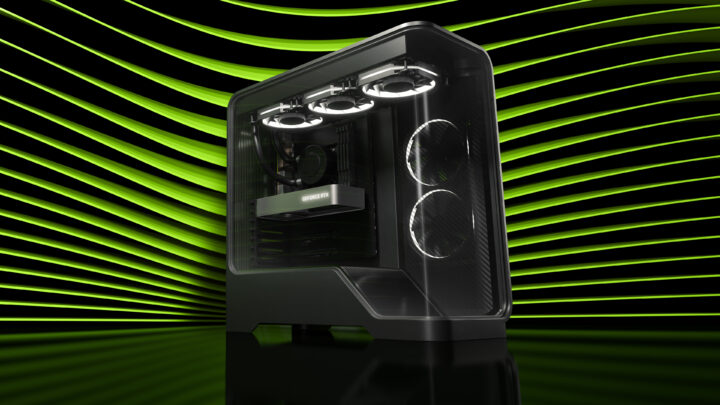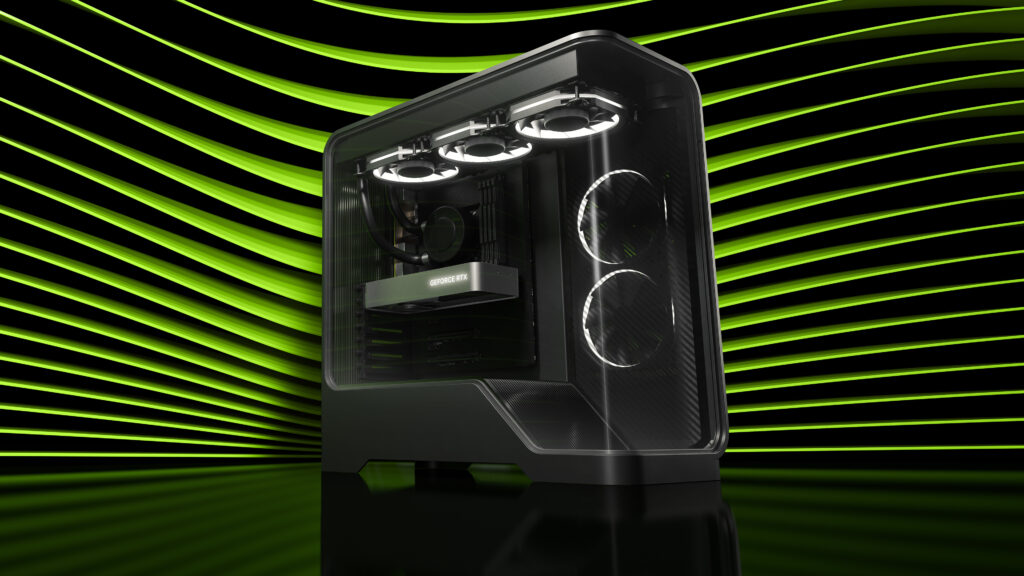
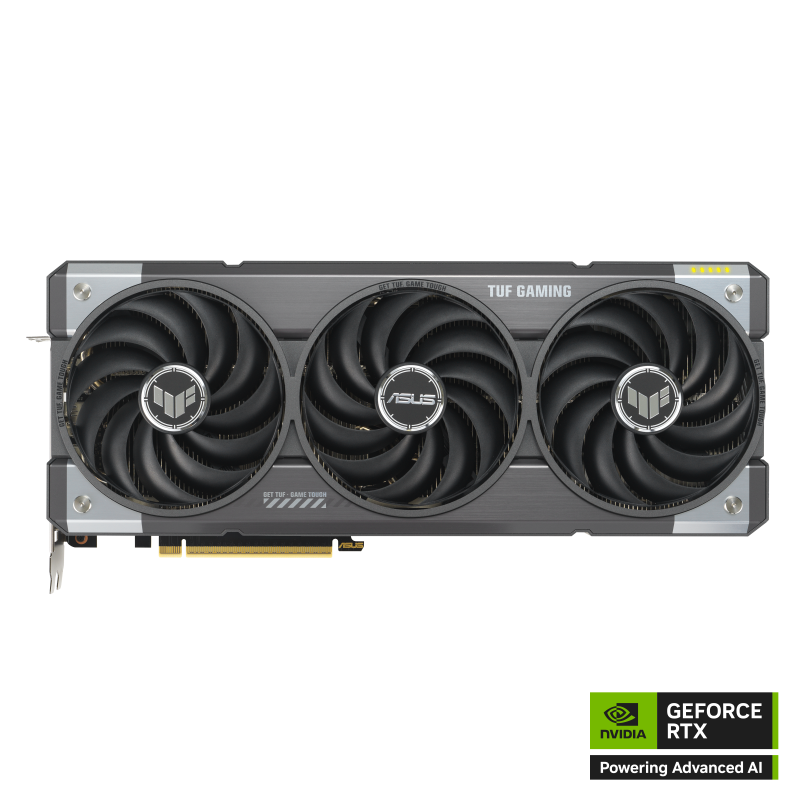
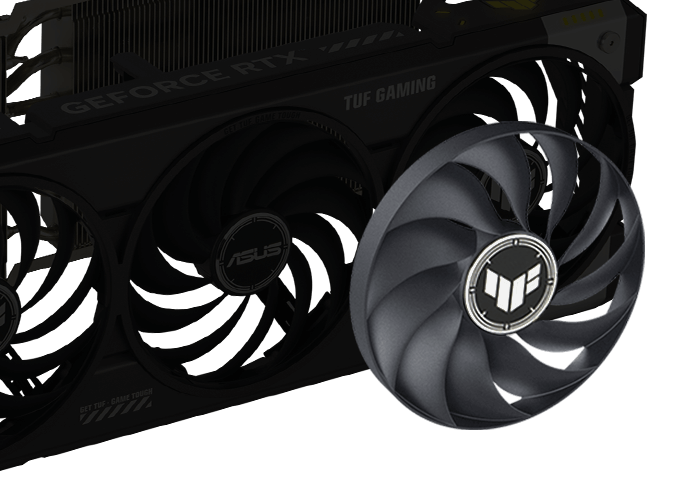
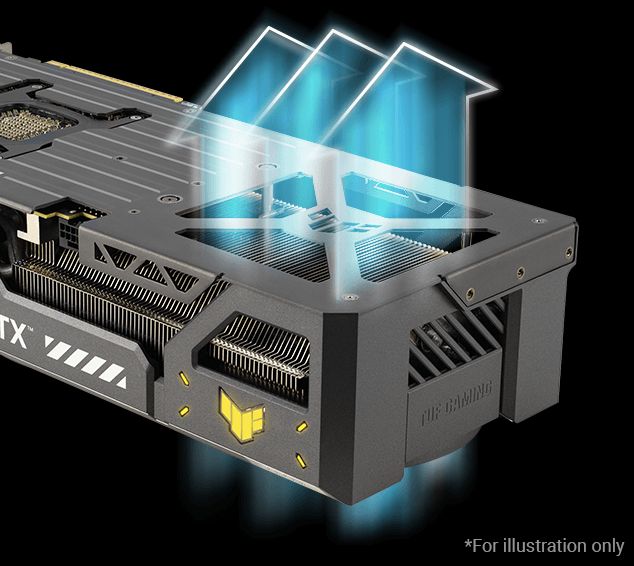
The NVIDIA GeForce RTX 5070 Ti is a high-end Blackwell graphics card designed for high-refresh 1440p gaming and capable 4K play. It launched on 20 February 2025 at recommended prices of $749 in the United States and £729 in the United Kingdom. Unlike the RTX 5090 and RTX 5080, NVIDIA did not produce a Founders Edition, so every retail model is supplied by a board partner and its size, cooling system, clock profile and final price can vary.
RTX 5070 Ti specifications
The RTX 5070 Ti combines 8,960 CUDA cores with 16 GB of GDDR7 memory on a 256-bit interface. Its reference specification uses a 2.30 GHz base clock and a 2.45 GHz boost clock, while the 28 Gbps memory provides 896 GB/s of bandwidth. Factory-overclocked partner cards can use higher advertised clocks, but their real operating frequency also depends on temperature, power limits and the workload.
Blackwell adds fourth-generation ray-tracing cores and fifth-generation Tensor cores alongside NVIDIA’s DLSS 4 feature set. Supported games can use Super Resolution, Ray Reconstruction and Multi Frame Generation. Multi Frame Generation can make motion appear substantially smoother by inserting generated frames, although it does not replace the responsiveness or simulation updates of a matching native frame rate.
The 16 GB frame buffer is an important part of the card’s position. It provides more practical headroom for high-resolution textures, ray tracing, creative applications and GPU-accelerated workloads than an 8 GB or 12 GB card. Capacity alone does not determine performance, but 16 GB is a sensible amount for a premium 1440p or 4K graphics card intended to remain useful for several years.
Display, video and platform features
The reference platform provides three DisplayPort 2.1b connections with UHBR20 and one HDMI 2.1b connection. It supports up to four displays and, with Display Stream Compression, configurations up to 4K at 480 Hz or 8K at 165 Hz. Actual output combinations still depend on the monitor, cable, colour format and graphics-card implementation.
For video work, the RTX 5070 Ti includes two ninth-generation NVENC encoders and one sixth-generation NVDEC decoder with AV1 encode and decode support. It also supports NVIDIA Studio drivers, Broadcast features, Reflex 2 and the wider CUDA software ecosystem. These features make it relevant to streamers and creators as well as gamers, although performance and acceleration depend on the application.
Power and installation requirements
NVIDIA rates total graphics power at 300 W and lists a 750 W required system power figure for its reference configuration. A partner card may recommend a different capacity, particularly when it uses a higher power limit or factory overclock. Buyers should follow the card manufacturer’s requirement and choose a reputable power supply with adequate headroom for the processor and the rest of the system.
Power can be supplied through two conventional PCIe eight-pin plugs and the supplied adapter, or through a compatible PCIe Gen 5 cable rated for at least 300 W. Every connection should be fully inserted and the cable should have enough space to avoid a sharp bend beside the socket.
There is no single official length, height, slot thickness or cooler specification because the RTX 5070 Ti is sold only through partner manufacturers. Check the exact model’s dimensions against the case, radiator, expansion slots and cable clearance before buying. Large triple-fan versions can occupy significantly more space than compact models bearing the same GPU name.
How the RTX 5070 Ti performs
Independent launch testing places the RTX 5070 Ti between the RTX 4070 Ti Super and RTX 5080. TechSpot measured an average lead of 7% over the RTX 4070 Ti Super at 1440p and 11% at 4K across its rasterised game suite. The RTX 5080 remained around 12–13% faster in those aggregate results. Individual games vary, so these figures should not be treated as a promise for every title.
The card is best understood as a very strong 1440p option with enough performance and memory for 4K gaming when settings are chosen sensibly. Ray tracing and DLSS support are significant advantages in compatible games, while native performance and the underlying rendered frame rate should remain the basis of comparisons.
Price and buying context
The launch prices of £729 and $749 are reference points rather than a guarantee of the price charged for a particular partner card. Cooling design, factory overclocking, availability and retailer margin all affect the total. A modest premium can be reasonable for quieter cooling or a format that suits a specific case, but a large premium can place the card uncomfortably close to RTX 5080 pricing.
Retailer modules on 5000 Series are updated separately from this specification record. Until verified retailer relationships are active, no affiliate offer is presented as current. Always confirm the exact model, final checkout price, delivery terms, warranty and returns policy with the retailer.
Read the complete assessment
For independently published 1440p, 4K and ray-tracing results, value analysis and our buying verdict, read the NVIDIA GeForce RTX 5070 Ti Review. You can also compare the specification with the flagship RTX 5090 and the faster RTX 5080.
Sources
Specifications, launch date and recommended pricing are based on NVIDIA’s official RTX 5070 family specifications and RTX 50 Series launch information. Performance context is attributed to TechSpot’s independent RTX 5070 Ti review. Sources were checked on 3 September 2026.