Quick verdict
The Intel Arc B570 offers a welcome 10GB of graphics memory, competent 1080p gaming and usable 1440p results in many games. Intel’s Xe2 architecture and XeSS support make it more interesting than a bare specification sheet suggests. Yet the 12GB B580 is usually the more attractive member of this pair when the price gap is modest. A buyer should compare actual local prices, platform support and favourite games before choosing the B570. This is an evidence-based assessment of published independent tests; 5000 Series has not performed its own laboratory benchmarks.
Good for: a modern budget PC with Resizable BAR enabled, predominantly 1080p gaming, and occasional 1440p gaming with adjusted settings or supported upscaling.
Reasons to pause: a B580 priced only slightly higher; inconsistent frame pacing in some games; older CPU and API combinations that can expose overhead; and a local B570 price that has drifted far above its original MSRP.
Specification comparison
| Specification | Arc B570 | Arc B580 |
|---|---|---|
| Architecture | Xe2 / Battlemage | Xe2 / Battlemage |
| Xe-cores | 18 | 20 |
| Ray tracing units | 18 | 20 |
| Graphics memory | 10GB GDDR6 | 12GB GDDR6 |
| Memory bus | 160-bit | 192-bit |
| Memory bandwidth | 380GB/s | 456GB/s |
| Total board power | 150W | 190W |
| PCI Express interface | PCIe 4.0 x8 | PCIe 4.0 x8 |
| US launch price | $219–$220 | $249–$250 |
The hardware entries come from Intel’s product specifications; launch prices are historical announcement prices, not live offers. Partner cards may differ in cooling, size, connectors and clocks. Intel’s B570 product page also lists 2,500MHz graphics clock, 19Gb/s memory and four supported displays. Intel B570 specifications · Intel B580 specifications · Intel launch announcement
The B570 gives up two Xe-cores and two gigabytes of memory, but the reduction in bandwidth is larger: 380GB/s versus 456GB/s. Its 150W board power is also lower than the B580’s 190W. These figures describe the GPU, not the wattage of a complete gaming PC. For an existing system, check the exact board partner’s power connector and case clearance before buying.
1080p gaming: capable, with uneven edges
The B570’s strongest case is a reasonably priced modern entry GPU. At 1080p, many games are playable at high settings, although demanding recent titles may require a quality adjustment. Its 10GB capacity gives a little more room for textures than common 8GB alternatives; it does not guarantee that every demanding game will run smoothly or that maximum settings will fit comfortably. Memory capacity is only one part of performance.
Published reviews reveal material variation by game. GamersNexus measured 55fps average in Dying Light 2 ray tracing at 1080p and found the RTX 4060 about 5% ahead in that test; Dragon’s Dogma 2 ray tracing was much less favourable to Intel. Its Final Fantasy XIV testing suggested that lower-end CPUs did not always cause a large change in averages, while some low-percentile results declined. Those are specific settings and platforms, not universal B570 frame-rate claims. GamersNexus B570 test
TechSpot found several games where changing from a Ryzen 7 9800X3D to a Ryzen 5 5600 altered the B570’s position against the RTX 4060 and RX 7600. In its Spider-Man Remastered test, a strong lead over the RX 7600 on the faster processor disappeared with the Ryzen 5 5600. It also documented less favourable upscaling results and 1% lows in some games. This is why a review must discuss the likely budget PC pairing instead of relying only on a premium CPU test bench. TechSpot B570 review
The two labs do not report identical conclusions about CPU overhead because their games, settings and CPU controls differ. Treat the issue as a reason to inspect results for the games you play, particularly if upgrading an older machine, rather than an automatic disqualification.
1440p: selective rather than effortless
Intel markets its desktop B-series for 1440p gaming, and the B570 can meet that goal in lighter or well-optimised games. It is less comfortable in the most demanding titles at native resolution. GamersNexus recorded 75fps average for the B570 versus 86fps for the B580 in Final Fantasy XIV at 1440p, but 46fps versus 54fps in Cyberpunk 2077: Phantom Liberty. In Baldur’s Gate 3 at 1440p, it recorded about 67fps on the B570, with the B580 roughly 11% faster. These figures are from one lab’s specified test setup and should never be mixed into a cross-lab average. GamersNexus B570 test
TechSpot’s tested 1440p game average with a Ryzen 7 9800X3D put the B570 13% behind the B580. With a Ryzen 5 5600, its native-resolution gap narrowed to 8%; with upscaling, its relative performance varied further. A smaller gap with a slower CPU can indicate that the faster card is being constrained, so it is not itself evidence that the B570 gained GPU performance. TechSpot B570 review
At this price tier, start at native 1080p or 1440p with sensible settings, then use XeSS in a supported title when you need more performance. Compare image quality and input response as well as the displayed frame counter. Frame generation should be assessed separately from native rendering and should not be added to native fps charts.
Ray tracing, XeSS and creators
The B570 has 18 ray tracing units and Intel’s XMX engines for AI-assisted features. Ray tracing is feasible in selected games, especially with restrained settings and upscaling, but it can be too costly in harder scenes. Independent examples point in both directions: GamersNexus found the B570 close to the RTX 4060 in its Dying Light 2 RT test at 1080p, while Dragon’s Dogma 2 RT was weaker. A blanket claim that one card wins ray tracing would misrepresent this variation. Intel specifications · GamersNexus results
XeSS 2 encompasses upscaling, frame generation and a latency feature, but support and behaviour depend on each game. Intel also advertises Arc’s media and AI capabilities. For a buyer whose main use is video encoding or local AI, verify application support and measured performance for that workload; this gaming-focused review does not claim to benchmark creator apps. Intel desktop B-series overview
Power, compatibility and the upgrade check
The B570’s 150W total board power is moderate, but it is not a substitute for checking a specific card and system. GamersNexus measured around 30W idle on its configured test platform, indicating that idle behaviour may matter to an always-on PC. This was a measurement of its sample and test configuration, not Intel’s guaranteed specification. Intel specification · GamersNexus measurements
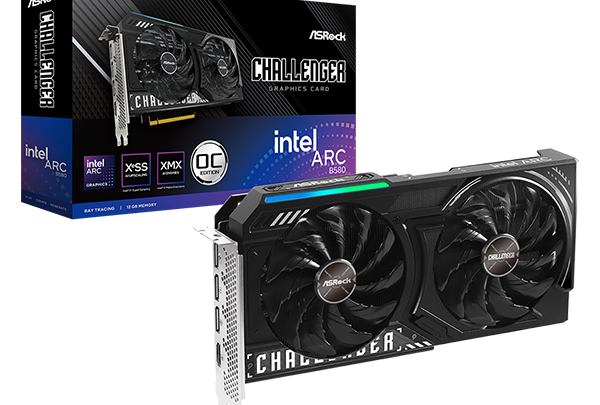
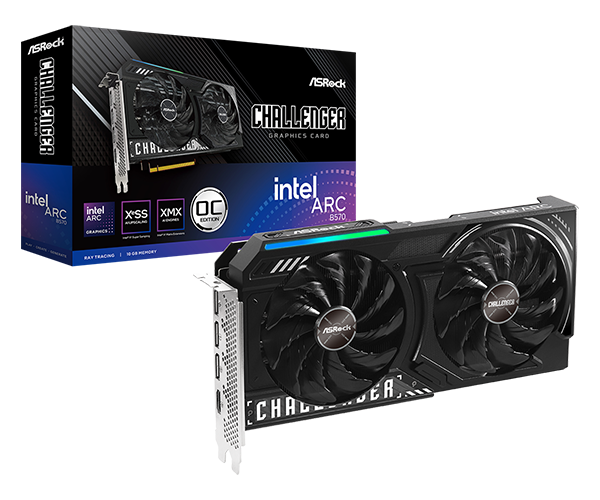
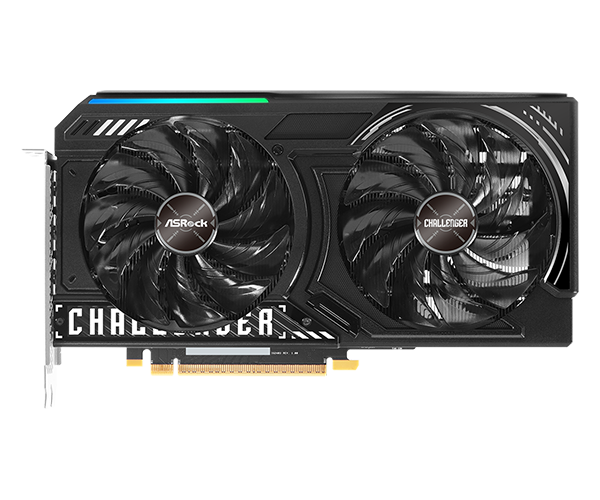
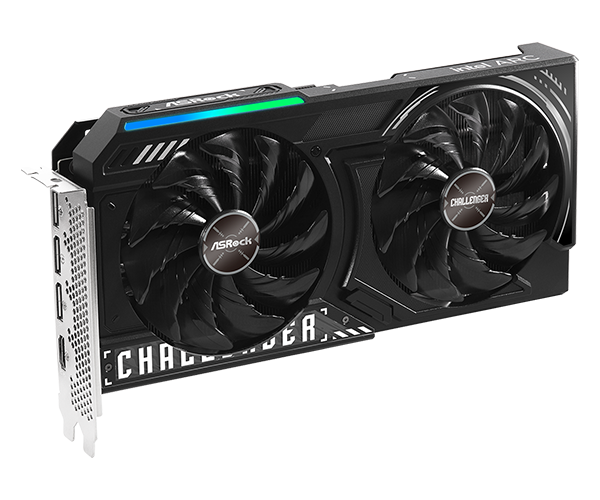
Check motherboard firmware and Resizable BAR support, available PCIe slot space, PSU connectors, case length and current driver support. An older PCIe platform or CPU may change the value calculation, particularly if the computer cannot enable the features Intel recommends. Verify the exact partner model rather than assuming all B570 cards match a reference photograph or cooler.
Is the B570 better value than the B580?
At their historical US launch prices, the $219 B570 was only $30 below the $249 B580. That extra amount bought 12GB instead of 10GB, more bandwidth and, in TechSpot’s 1440p test suite on a high-end CPU, about 13% more average performance. If those two cards are still separated by roughly that amount at a reputable local retailer, our recommendation is the B580 for most buyers. The B570 becomes more attractive when its real price is materially lower, when the B580 is unavailable, or when the lower board power and a suitable compact partner design matter. Intel launch PDF · TechSpot test
A launch MSRP from January 2025 should not be displayed as a September 2026 current price. The Product page’s UK GBP and US USD offer modules need a fresh retailer check, with timestamps and an explicit non-affiliate label wherever appropriate. Compare the final checkout price, returns policy and warranty, as well as competing cards in stock. No fixed current-price recommendation is justified until this check is done.
Retailer offers
Where to buy
Prices and availability are checked manually and may change. Confirm the final price with the retailer before buying.
Affiliate disclosure: We may earn a commission from qualifying purchases made through marked links, at no extra cost to you.
International / other
-
Scan UK Availability not confirmedCheck retailer for current price Last checkedCheck UK price (non-affiliate) (opens in a new tab)
-
Overclockers UK Availability not confirmedCheck retailer for current price Last checkedCheck UK price (non-affiliate) (opens in a new tab)
-
Newegg US Affiliate link Availability not confirmedCheck retailer for current price Last checkedCheck current price at Newegg (opens in a new tab)
-
B&H Photo Video Availability not confirmedCheck retailer for current price Last checkedCheck US price (non-affiliate) (opens in a new tab)
Verdict
The Arc B570 makes a credible modern budget card with 10GB of VRAM and an appealing feature set. It is best judged as a sensible 1080p card that can also handle selected 1440p games with thoughtful settings. The B580’s 12GB buffer and generally stronger results make the larger model an easy upgrade when the actual price gap is small. For a budget machine, examine the games and CPU you own, confirm Resizable BAR and buy the exact partner card at a price that makes the trade-off worthwhile.
Our 78/100 score combines performance, features, design and value. The B570 earns credit for capable 1080p gaming, 10GB of memory, XeSS 2 features and moderate 150W board power. Its value score is restrained because the faster 12GB B580 launched only $30 / £30 higher and is normally the stronger purchase when the real retailer gap remains small.
Frequently asked questions
Is 10GB enough for 1440p?
It can be, but memory capacity alone does not determine frame rates. The B570 has useful 1440p results in several tested games, while demanding releases may need reduced settings or upscaling. The B580’s 12GB and higher bandwidth provide more headroom if the price difference is small.
Does the B570 require a new power supply?
Intel lists 150W total board power. Check the complete PC’s power needs and the exact B570 manufacturer’s connector requirement before ordering; there is no single PSU answer for every system.
Is it better than the B580?
Generally no when both sell near their original $30 US launch-price gap. The B570 is worth considering when its actual local price is substantially lower, the B580 is unavailable or a particular lower-power build favours it.
Does XeSS frame generation make native gaming faster?
It can increase the displayed frame rate in supported games, but generated frames are not the same measurement as native rendered frames. Start with a responsive base frame rate and compare image quality and latency as well as the display counter.
See the B570 Product page for specifications and buying checks, or compare the B580 review. This is an evidence-based editorial review; 5000 Series has not directly benchmarked the card.