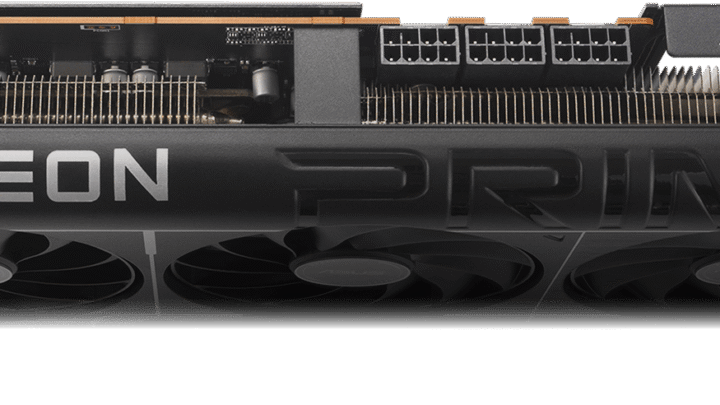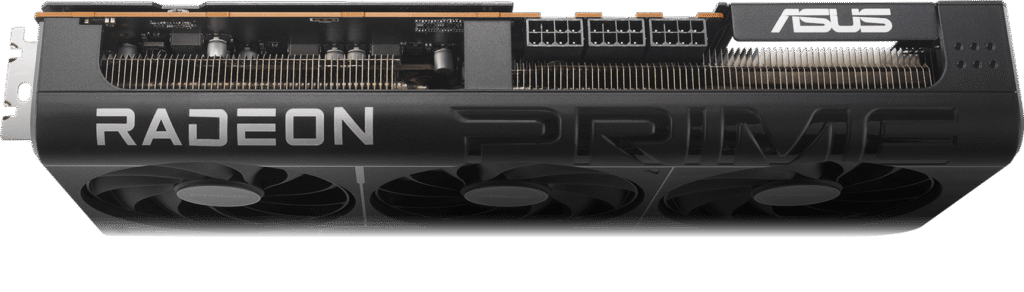
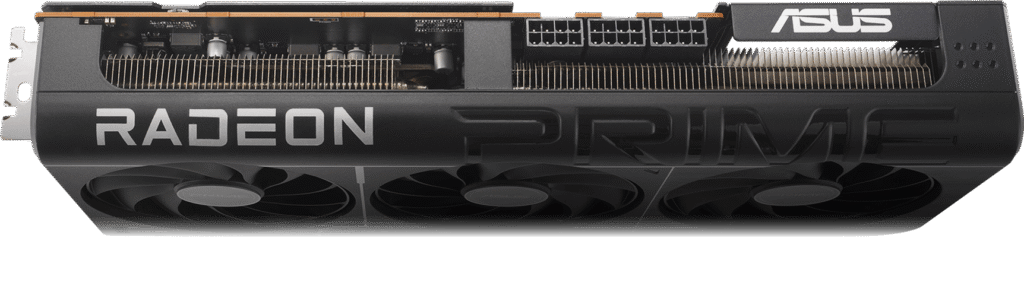
AMD Radeon RX 9070 XT is AMD’s faster RDNA 4 gaming card for high-refresh 1440p and 4K. This Product record combines the official specification, launch price and practical buying context. The linked 5000 Series Review is evidence-based: we have not tested the card directly and cite the independent measurements used.
Product overview
It combines 64 compute units, 16GB of memory and a substantial 304W board-power target. RDNA 4 improves ray tracing and adds FSR 4-era machine-learning features, while aggressive launch pricing made raster performance its core appeal.
The card launched at $599 in the United States and £569 in the United Kingdom. Those are historical launch figures. Partner coolers, factory overclocks, stock and regional tax can produce very different live prices.
Core specifications
- 64 RDNA 4 compute units, 64 ray accelerators and 128 AI accelerators
- 4,096 stream processors
- 16GB GDDR6 on a 256-bit interface
- 20Gbps memory and 640GB/s bandwidth
- 2.40GHz game clock and up to 2.97GHz boost
- 304W typical board power; 750W recommended system supply
Gaming position
Independent launch testing positioned it close to more expensive high-end competitors in rasterised games and as a particularly strong value at its intended MSRP. Ray tracing improved materially over RDNA 3, although the lead varies by engine and effect complexity.
Sixteen gigabytes gives an appropriate buffer for its performance class and supports high-resolution textures more comfortably than 12GB alternatives. It does not erase every bandwidth or software limitation, but capacity is unlikely to be the first concern.
FSR, ray tracing and media features
RDNA 4 supports AMD FidelityFX Super Resolution 4 features in compatible games, hardware ray tracing, HYPR-RX and Anti-Lag technologies. Upscaling and generated frames should be evaluated separately from native performance and latency.
AMD’s updated media and display engines support modern AV1 workflows and DisplayPort 2.1a. Creator-application behaviour is software-specific, so CUDA-dependent workloads may still favour GeForce.
Power and compatibility
At 304W the card needs deliberate airflow and a suitable supply, but standard dual 8-pin inputs on reference specifications avoid a 16-pin adapter. Partner boards may raise limits or use larger coolers.
The host interface is PCI Express Gen 5 x16 and official display support includes DisplayPort 2.1a and HDMI 2.1b. Physical dimensions, slot thickness and connector placement vary between partner models unless a reference-card size is stated.
Who should consider it?
It is a strong fit for a performance-focused 1440p or 4K gamer who values 16GB capacity and raster value. Buyers dependent on CUDA or the broadest ray-tracing performance should check their exact applications and games.
The most relevant alternative is NVIDIA’s RTX 5070 Ti; the non-XT RX 9070 is the lower-power alternative. Compare real street prices, memory capacity, ray-tracing priorities, software support and power-supply requirements rather than relying on model names alone.
UK and US price checks
The retailer buttons are plain, non-affiliate links. 5000 Series receives no commission from them. They are included so readers can check regional stock and prices while affiliate applications are pending. Future tracked links will be clearly labelled and will not affect the editorial score.
Review and source notes
Read the full AMD Radeon RX 9070 XT Review for the evidence-based verdict, comparisons, strengths and limitations. The specification was checked against AMD’s official product information; independent benchmark sources are attributed in the Review.
Before ordering
Confirm the exact board model, warranty, return terms and whether the listing is new, open-box, refurbished or used. Launch MSRP is useful for historical comparison, but the value conclusion should always be revisited at the live price available to you.