Specifications compared
| Specification | Intel Arc B570 | Intel Arc B580 | Practical difference |
|---|---|---|---|
| Architecture | Xe2 / Battlemage | Xe2 / Battlemage | Same generation and feature family |
| Xe-cores | 18 | 20 | B580 has 11% more |
| Ray-tracing units | 18 | 20 | B580 has 11% more |
| XMX engines | 144 | 160 | B580 has 11% more |
| Graphics clock | 2,500MHz | 2,670MHz | Official GPU specification |
| Graphics memory | 10GB GDDR6 | 12GB GDDR6 | B580 has 20% more capacity |
| Memory interface | 160-bit | 192-bit | B580 has 20% wider bus |
| Memory bandwidth | 380GB/s | 456GB/s | B580 has 20% more bandwidth |
| Total board power | 150W | 190W | B570 is rated 40W lower |
| PCI Express | PCIe 4.0 x8 | PCIe 4.0 x8 | No difference |
| US launch price | $219 | $249 | $30 / about 14% more |
| UK launch price | £219 | £249 | £30 / about 14% more |
The B580’s advantage is larger than its two extra Xe-cores suggest. Its wider memory subsystem gives it 76GB/s more bandwidth, while the extra 2GB of VRAM provides more room for textures and other data. The B570’s clearest hardware advantage is its 40W lower board-power rating.
Card design and size: compare the exact partner models
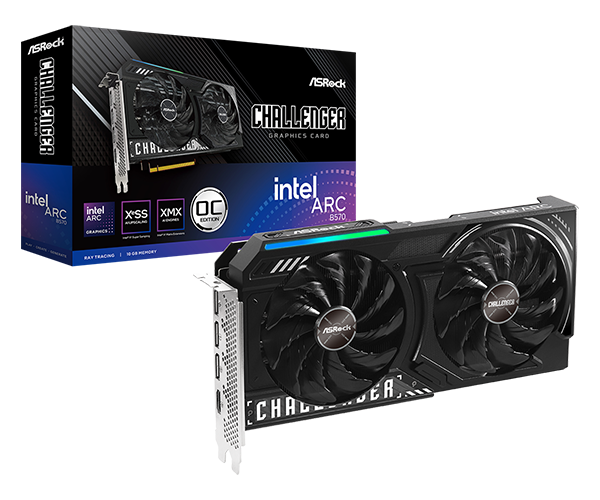
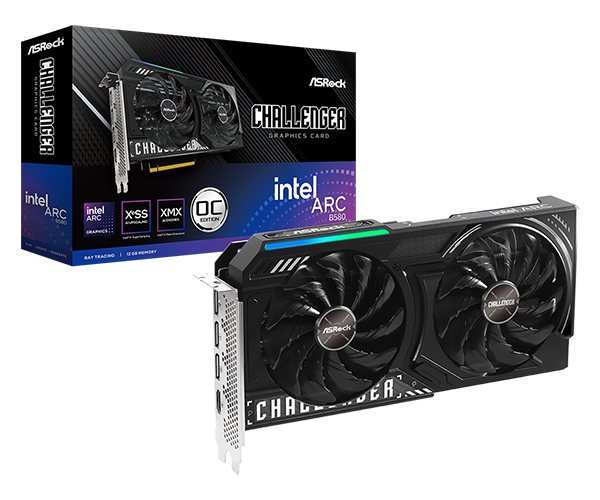
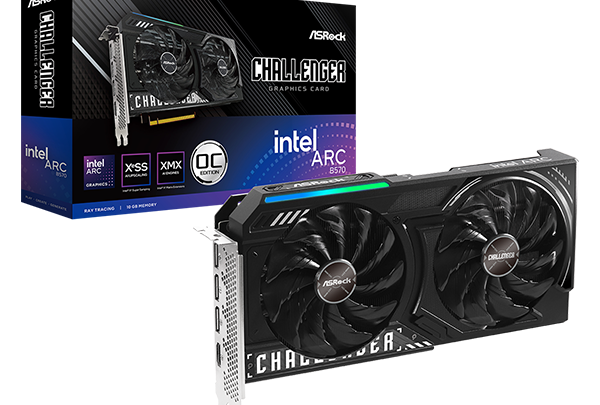
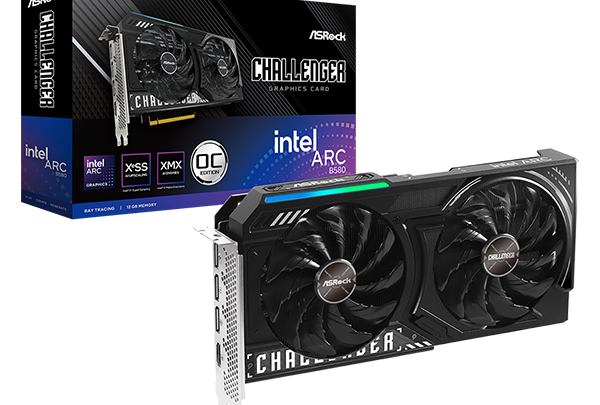
These photographs show comparable ASRock Challenger partner cards, not universal reference designs. A card sold under the same GPU name can use a different cooler, PCB, factory clock, power limit, connector position or warranty. Confirm the complete model code and measure case clearance before ordering.
Gaming performance: how much faster is the B580?
Across directly comparable high-load tests, the B580 is normally around a mid-teens percentage faster. That is broadly proportional to its original price premium, but the exact difference changes with resolution, game, processor and driver.
Final Fantasy XIV at 1440p
GamersNexus measured 75fps average for the B570 and 86fps for the B580 in its specified 1440p test, putting the B580 about 15% ahead. This is one game and one test platform—not a universal frame-rate promise.
Cyberpunk 2077: Phantom Liberty at 1440p
In the same publisher’s Cyberpunk: Phantom Liberty 1440p test, the B570 produced 46fps average and the B580 54fps, a lead of about 17%. GamersNexus also reported weaker low-percentile behaviour on the B570 than some neighbouring products, reinforcing why averages alone are not enough.
TechSpot’s multi-game 1440p testing with a Ryzen 7 9800X3D placed the B570 13% behind the B580. When paired with a Ryzen 5 5600, the native-resolution gap narrowed, but that does not mean the B570 became faster: a slower CPU can constrain the higher-performing card and change the relative ranking.
Performance conclusion: the B580 is meaningfully faster, but not in every game by the same amount. Check a recent benchmark for your priority titles, especially older APIs, CPU-heavy games and ray-tracing workloads.
1080p gaming: the B570’s strongest case
At 1080p, the B570 can deliver capable high-setting performance in many games. Its 10GB memory capacity is more comfortable than 8GB alternatives when a title uses higher-quality textures, although capacity cannot compensate for every driver, CPU-overhead or frame-time limitation.
The B580 still wins overall, but a sufficiently discounted B570 can be the more rational purchase for a 1080p monitor. Buyers targeting very high refresh rates should pay particular attention to CPU and API behaviour: Intel Arc results can shift when paired with an older or slower processor.
1440p gaming: the B580 is the safer choice
Both cards can run selected games well at 1440p, and Intel positioned the B-series for that resolution. The B580 is the stronger and more consistent choice because it combines more GPU resources, 12GB of memory and 20% more memory bandwidth.
The B570 remains viable when settings are chosen carefully, but more demanding games may require reduced quality or upscaling. If 1440p is the primary resolution and the B580 costs only modestly more, saving on the B570 usually creates the less balanced system.
10GB vs 12GB VRAM
Neither capacity is automatically “future-proof,” but 12GB gives the B580 more headroom for high-resolution textures, ray-tracing data, mods and selected creation or AI workloads. Memory bandwidth also matters: the B580 moves resident data at 456GB/s versus 380GB/s for the B570.
Allocated memory is not the same as required memory, and a larger buffer does not guarantee a higher frame rate. When a workload genuinely exceeds local capacity, however, symptoms can include lower texture quality, asset streaming, stutter or a sharp performance loss. For a long-lived 1440p build, the B580’s memory subsystem is a real advantage rather than a marketing-only difference.
Power consumption, PSU and cooling
Intel rates the B570 at 150W total board power and the B580 at 190W. The 40W difference can matter in a compact build, a warm room, a quiet-PC project or a system used for many hours each week. It does not mean every B570 is silent or every B580 is difficult to cool; the partner-card cooler and BIOS matter.
Both GPU specifications use PCIe 4.0 x8. Check the exact card’s power connector, recommended PSU, length, height and slot thickness. The Product pages currently list a 600W recommendation for the featured ASRock B570 and Intel Limited Edition B580 configurations, but a quality PSU should be selected for the complete system rather than from wattage alone.
XeSS 2, ray tracing and media features
Because both cards use Xe2 Battlemage, their fundamental feature set is similar. They support hardware ray tracing, XMX acceleration, XeSS features and AV1-capable media encode/decode. The B580 has more execution resources, so it normally handles demanding effects better, but neither card should be purchased on generated-frame claims alone.
Upscaling can improve performance in supported games. Frame generation can increase the displayed frame rate, but it works best from an already responsive base and should not be compared directly with native rendering. Application support is equally important for streaming, video editing, local AI and professional software—verify the current version of the software you actually use.
Resizable BAR and older-PC compatibility
Resizable BAR should be enabled for the intended Intel Arc experience. Before purchasing either card, confirm motherboard firmware support, CPU/platform compatibility and the BIOS setting. This is particularly important when upgrading an older budget PC, where Arc’s CPU overhead in some games can also change the value calculation.
If your system cannot support Resizable BAR, or if a critical game or professional application is known to behave poorly on Arc, a GeForce or Radeon alternative may be the safer purchase even when its specification sheet looks less generous.
Price and value: how large should the gap be?
The historical launch gap was only $30 / £30: about 14% more money for the B580. That was a strong trade because independent 1440p results often placed the B580 around 13–16% ahead, alongside its extra memory and bandwidth.
- Gap below 15%: buy the B580 unless the B570’s lower power is essential.
- Gap around 15–20%: the B580 remains preferable for 1440p and longer-term headroom; the B570 becomes credible for 1080p.
- Gap above 20%: calculate cost per frame and consider the B570, while also comparing current Radeon and GeForce alternatives.
Use delivered prices, not currency conversion or an old MSRP. UK prices normally include VAT; US prices usually exclude local sales tax. Compare warranty handling, returns and whether the listing is new, open-box, refurbished or marketplace supplied.
Which Intel Arc card should you buy?
Buy the Arc B570 for a discounted 1080p build
The B570 is the sensible choice when its street price is materially lower and your main target is 1080p. Its 10GB buffer, modern media engine and 150W rating make it a useful entry card in the right system.
Buy the Arc B580 for 1440p and the best overall value
The B580 is our recommendation for most buyers choosing only between these two cards. Its 12GB memory, wider bus and higher performance justify a modest premium, particularly at 1440p.
Choose neither if platform or software compatibility is doubtful
A graphics card is only good value when it works well in the games and applications you use. If your motherboard lacks Resizable BAR, your processor is likely to expose significant overhead, or critical software has stronger support elsewhere, compare the current alternatives before deciding.
Retailer offers
Where to buy the Intel Arc B570 and Intel Arc B580
Compare current retailer availability for each card. Prices can change, so confirm the final total before buying.
Intel Arc B570
Intel Arc B570 offers
Prices and availability are checked manually and may change. Confirm the final price with the retailer before buying.
Affiliate disclosure: We may earn a commission from qualifying purchases made through marked links, at no extra cost to you.
International / other
-
Scan UK Availability not confirmedCheck retailer for current price Last checkedCheck UK price (non-affiliate) (opens in a new tab)
-
Overclockers UK Availability not confirmedCheck retailer for current price Last checkedCheck UK price (non-affiliate) (opens in a new tab)
-
Newegg US Affiliate link Availability not confirmedCheck retailer for current price Last checkedCheck current price at Newegg (opens in a new tab)
-
B&H Photo Video Availability not confirmedCheck retailer for current price Last checkedCheck US price (non-affiliate) (opens in a new tab)
Intel Arc B580
Intel Arc B580 offers
Prices and availability are checked manually and may change. Confirm the final price with the retailer before buying.
Affiliate disclosure: We may earn a commission from qualifying purchases made through marked links, at no extra cost to you.
International / other
-
Scan UK Availability not confirmedCheck retailer for current price Last checkedCheck UK price (non-affiliate) (opens in a new tab)
-
Overclockers UK Availability not confirmedCheck retailer for current price Last checkedCheck UK price (non-affiliate) (opens in a new tab)
-
Newegg US Affiliate link Availability not confirmedCheck retailer for current price Last checkedCheck current price at Newegg (opens in a new tab)
-
B&H Photo Video Availability not confirmedCheck retailer for current price Last checkedCheck US price (non-affiliate) (opens in a new tab)
Final verdict
Winner: Intel Arc B580 12GB. The B580 turns a small launch-price premium into a useful performance increase, two extra gigabytes of memory and 20% more bandwidth. It is the better-balanced 1440p card and the stronger long-term purchase when the real price difference remains modest.
The B570 is not a bad card. It becomes the better-value option only when discounting creates a larger price gap, or when its 40W lower board-power rating has particular value. For most buyers, paying a little more for the B580 is the safer recommendation.